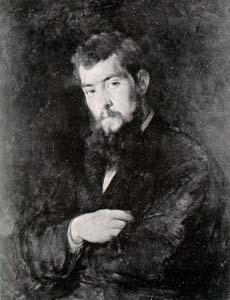
Lovis Corinth Biography
Lovis Corinth (1858 - 1925)
Lovis Corinth
was born on July 21, 1858, at Tapiau in eastern Prussia. As a child he sought
relief from his hostile brothers and sisters by drawing. His ability was noticed
by his father, a master tanner, who sent him to study art in Koigsberg on the
Baltic.
At the age of 20,
Corinth
went to the Munich Academy, and at 26 to Paris, where he took lessons at the
Academie Julian and painted mostly portraits. He was unmoved by what he saw of
Impressionism in Paris,
but admired the realism of a painting by Wilhelm Leibl, The Poachers, that was
on view there. Corinth's stylistic masters at the time were Rembrandt, Rubens,
Frans Hals, Velazquez, and the realist par excellence, Gustave Courbet. When
Corinth
was in Paris more than 20 years later, he went daily to the Louvre.
He left Paris in 1887, lived for a short time in
Berlin, and then, apart from
frequent journeys in
Germany,
Switzerland, and Denmark, he settled in Munich until 1900. The enjoyable life he
had in Berlin
was mirrored in the work he did there, which grew richer and brighter as he laid
his pigments more thickly and freely. He opened an art school, and married one
of his first pupils. With Max Liebermann he became one of the leaders of German
Impressionism, though his vision remained closer to that of Rembrandt than to
that of any of the French Impressionists. When he visited Holland in the early
years of the 20th century, he still sought out and studied the works of
Rembrandt and Hals.
Corinth was partly incapacitated by a stroke in 1911, but quickly recovered and
in 1919 he built a house on the Walchensee, the scene of much of his later work.
His style became much looser during his last years, and in about 1916 his color,
in paintings now expressionist in feeling, became brighter and richer. A few
months before his death in July, 1925, in Holland, he wrote: "I have discovered
something new: true art is the representation of the unreal."
Corinth won recognition first in France, then in Germany. He showed at the Paris
Salon in 1884 and won an honorable mention there six years later. In 1911 he was
elected chairman and in 1915 president of the Berlin Sezession, where his 60th
birthday was celebrated in 1918. He was awarded the freedom of his birthplace,
Tapiau; an honorary doctorate at the university of Konigsberg, where there was a
large Corinth exhibition the year before he died; and honorary membership of the
Munich Academy.
Return to the Lovis Corinth Gallery
Please spend some time roaming our other galleries.
Artist Galleries A - F
Artist Galleries G - P
Artist Galleries Q - Z
Home Galleries by Subject Galleries by Artist Contact Us How to Order

All Rights Reserved to Canvas Replicas. 2016, 2017